Court Piece Strategy
9 Rang & Rung Tips to Play Smarter
Strong Court Piece strategy is built on more than high cards. Rang and Rung reward memory, timing, trump control, partnership and the ability to read what remains around the table. These 9 practical tips focus on smarter decisions, better hand management, effective trump selection and preparing for the right winning opportunity.
Read Your Hand: Know Where You Are Strong — and Where You Are Weak
A standard deck has four suits — Spades, Hearts, Diamonds and Clubs — with thirteen cards in each suit.
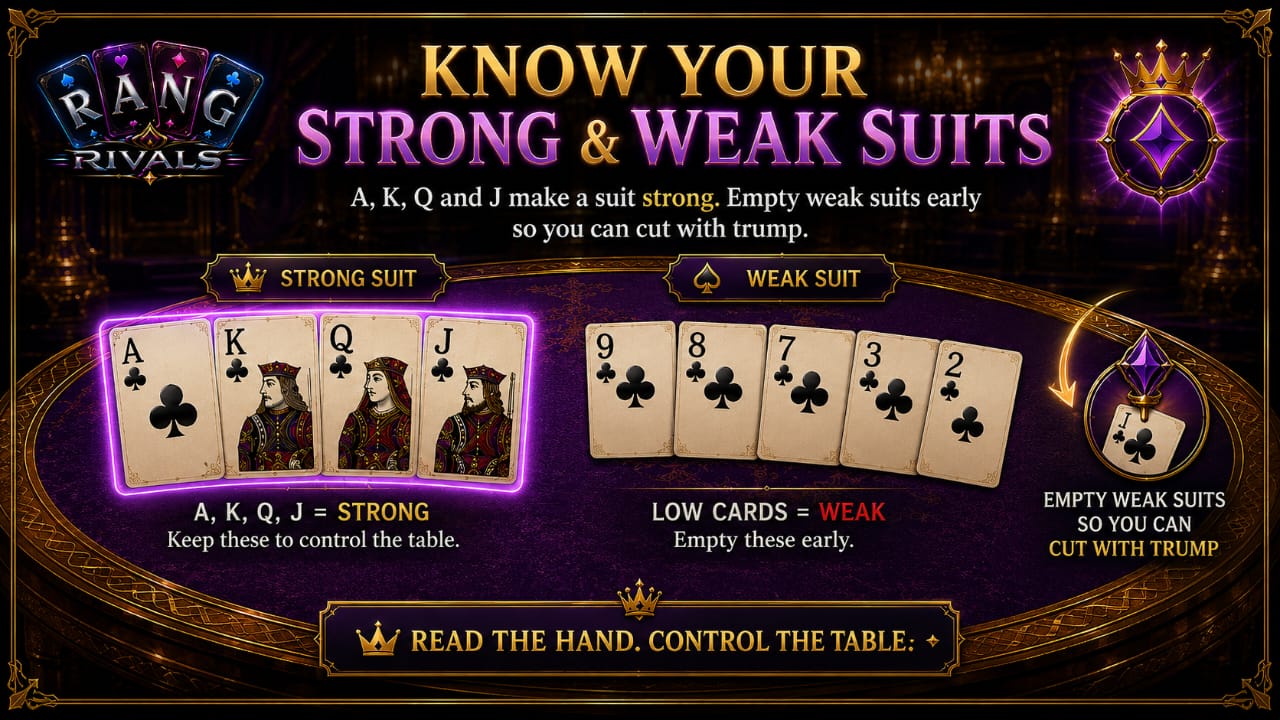
The most important high cards are normally the Ace, King, Queen and Jack. These cards often decide who controls an important trick.
When you hold several high cards in the same suit, especially two, three or four of these major cards, you are usually strong in that suit.
When you do not have control of a suit, your objective is often to make the opponents spend their high cards before the most important winning opportunities arrive.
Good players do not only look at the cards they have. They continuously think about the cards that must still be in the other three hands.
Pro habit: Keep a mental count of the important cards already played. The fewer unknown cards that remain, the easier it becomes to predict what your partner and opponents are holding.
Choose Your Trump Wisely
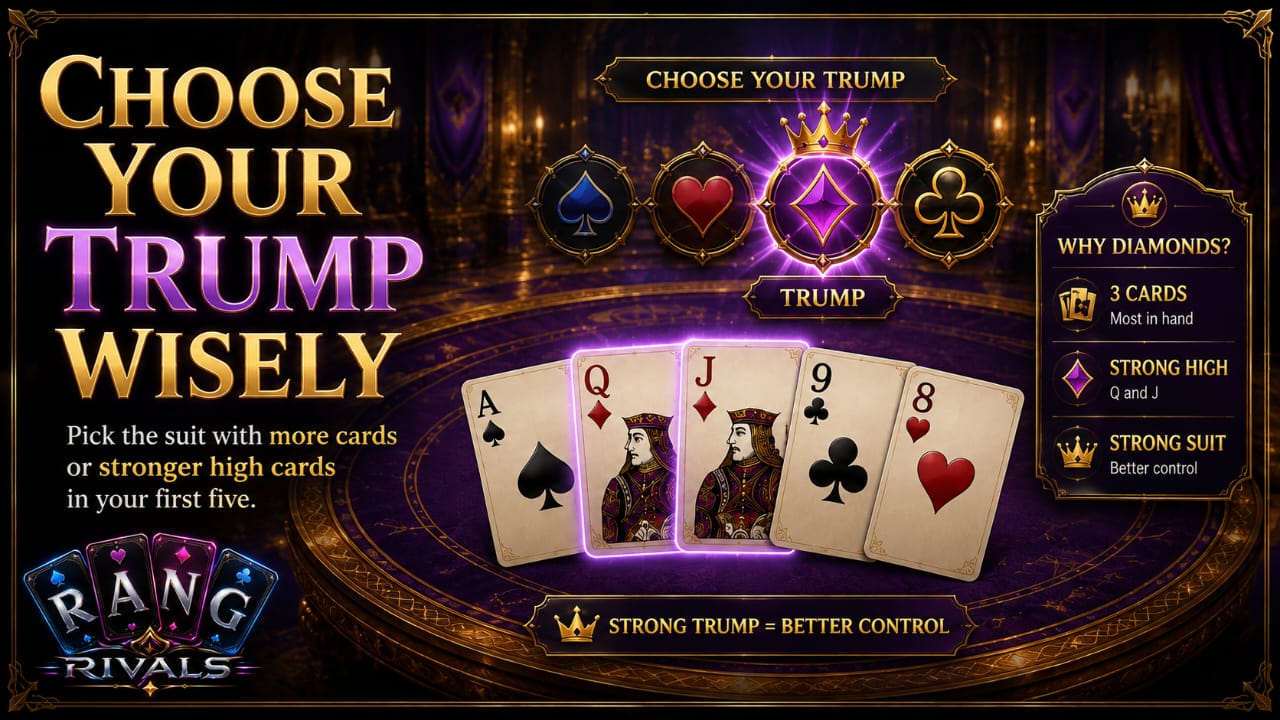
Strong Rang strategy starts with making a smart trump decision from the first five cards.
In a common Rang / Court Piece format, players first receive five cards, and the trump suit — Rang, Rung, Trump or Turup — is selected from the information available in those first cards.
A useful general rule is to choose the suit in which you have the best combination of high cards and numerical strength.
Having several cards of the same suit can be valuable because more cards are still to be dealt, giving you a chance to increase your strength in the suit you selected as trump.
Do not judge a trump suit from one attractive card alone. A single Ace can be powerful, but a longer suit with several useful cards may give you much greater control of the match.
Every Played Card Gives You Information
Once all thirteen cards are in your hand, count how many cards you hold in each suit. Since each suit contains thirteen cards in total, you immediately know how many cards of that suit are somewhere outside your hand.
You still do not know exactly how those cards are divided between your partner and the two opponents — but the first few tricks begin revealing the answer.
Pay special attention when a player changes suit after taking control of a trick. That change can be a clue that the player is strong in the previous suit, weak in the new one, or trying to communicate a plan.
Rang is therefore partly a memory game. Every Ace, King, Queen, Jack and trump card that disappears from the table reduces the number of possibilities you must consider.
Use Your Weak Suits to Create Future Trump Opportunities
One common early objective is to reduce the number of cards you hold in a suit where the opponents appear stronger.
The reason is simple: once you have no card left in that suit, an opponent may later lead that suit and give you the opportunity to cut it with a trump card.
This can stop an opponent from converting a strong suit into an important winning trick.
Experienced players therefore think several tricks ahead. A small card discarded now may create the winning position you need later.
You Cannot Play Rang Properly Without Reading Your Partner
One of the most important principles in Rang / Rung strategy is understanding that your partner’s cards and decisions are part of your plan.
Rang / Court Piece is fundamentally a partnership game. In most situations, trying to play every trick only for yourself will weaken the team.
One useful way to learn about the table is to lead a small card from a suit where you are uncertain or relatively weak. The responses from the other three players reveal valuable information.
When your partner becomes senior — meaning their card currently controls the trick — and then changes to a different suit on the next lead, pay attention.
That switch often means your partner does not want the previous suit repeated and prefers the new direction of play.
If your partner leads a suit in which you hold strong cards such as Ace, King, Queen or Jack, it is sometimes better to remain junior and preserve your strength rather than immediately showing every high card.
The decision depends on the table situation. Never sacrifice an important trick merely to hide information.

Manage Trump Before the Important Winning Opportunities
Whether you selected trump, your partner selected it or an opponent selected it, your team must quickly judge whether it is strong or weak in trump.
When your side appears weak in trump, a major objective is often to force the opponents to spend as many trump cards as possible before the decisive winning opportunities arrive.
This may be done by repeatedly playing suits that create cuts, or by forcing players who are void in a suit to use trump.
When your side is strong in trump, the opposite discipline becomes important: do not waste powerful trump cards on low-value situations when you may need them later.
Important: Count trump cards as they are played. Knowing whether one dangerous trump remains with an opponent can completely change your next move.
Easy Hits and Pro Masters Require Different Timing
Regional versions of Rang, Court Piece, Hokm and Rung can use different rules for when a scoring or winning trick becomes available. Rang Rivals therefore offers two distinct competitive modes.
Easy Hits
The first winning opportunity arrives on the third trick. After the first successful winning trick, later winning opportunities arrive every second trick.
Pro Masters
The first winning opportunity arrives on the fifth trick. After the first successful winning trick, later opportunities arrive every third trick.
To convert an eligible winning opportunity, timing matters. Your team normally needs to control the preceding trick and remain senior when the scoring opportunity arrives.
This is why Rang Rivals is not simply about holding powerful cards. You must preserve control for the right trick at the right time.

The Wins Everyone Wants — and the Defeats Everyone Fears
A match contains thirteen tricks, and the side that wins more scoring hands or tricks takes the match.
When your side selected the trump and completely prevents the opposition from winning a scoring hand, the opponents suffer Kot.
But when your side selected the trump and the opponents completely shut your team out without allowing a scoring hand, the result is the far more painful 52 Kot.
Avoiding 52 Kot is not only about defending individual tricks. It requires reading the whole match before control disappears.